

Published May 24, 2026
| 2 Comments | Leave A ReplyWhat interests you the most about your ancestors?
Is it simply just that they are your ancestors? Or does it go to something deeper than that?
And if it does go deeper than that, well, in what directions does that depth of research take you?
What about the ages at which your ancestors died?
I recently focused a “Roots & Branches” column on my mitochondrial DNA line, the “mother’s, mother’s, mother’s,” etc., line and it showed great variance from two generations of women living into their late 80s, followed by age 53 (cerebral embolism) and then 27 (acute pulmonary tuberculosis), the latter of which was my grandmother. She died when my mother was an infant (Mom rebounded to live to 83).
What were the occupations of your ancestors?
I often say—with more truth than facetiousness—that I stem from “Pennsylvania German farmer stacked upon Pennsylvania German farmer.” But what types of farmers were they? And was that their top source of cash or merely a vehicle for subsistence? And how much cash did they actually need?
Why did your ancestors move when they did?
My ancestors never seemed to move far, even if they did move often (or not—my mother lived in the house in which she was born until going to a nursing home a few years before her death.
Who were ancestors’ friends?
You might need preserved date books or lists of phone numbers (talk about a blast from the past, right?) to reconstruct this.
What were your ancestors’ favorite foods?
You might need to hope that some recipes were handed down in the family to help with this one, but here’s another hint: Church and community cookbooks likely will reflect some of them.
When did the key events in your ancestors’ lives happen?
This one’s actually a more basic, more traditional genealogical question. We’re often called upon as family historians to document the key “whens” of ancestors’ lives—when they were born, when they attended school, when they bought property, when married and had children, when they started working and when the retired. And, of course, when to died.
A point I often make about these type of “when” records is that there are usually more than one version of them, especially since many official records have also been historically covered in newspapers.
I especially think of death records, because so many people want to stop at an obituary or perhaps even just finding a tombstone. But there can be so much more—death registers and/or certificates; church or private pastoral burial registers; burial registers of cemeteries and graveyards, which may well include records of people buried without tombstones.
***
“Roots & Branchers,” these aren’t meant as rhetorical questions: What’s your No. 1 interest when you research?
2 Comments
For Sale
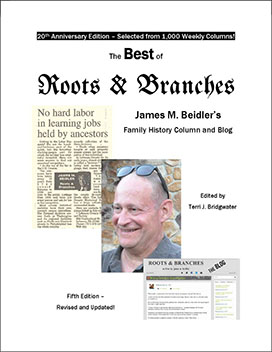
The Best of "Roots & Branches", Fifth Edition published July 2017, edited by Terri J. Bridgwater.
It contains a selection of columns from Beidler’s award-winning newspaper column (currently published in the Altoona Mirror), which is the only syndicated newspaper column on genealogy in Pennsylvania.
The book can be ordered online, or purchased directly from Jim when he speaks at a conference.
Elizabeth Bottorff Ahlemann
4 months ago
I think I’m trying to learn something about my ancestor’s personality. That kind of information is hard to come by, although, as you have pointed out, newspaper articles may provide wonderful clues. Court cases, also.
Looking forward to hearing you lecture at the National Genealogical Society conference in Ft. Wayne later this week!
Angie Michael
4 months ago
Recently I went through the 1940 U.S. Censuses for each of my great-grandparents to note the highest grade completed for each of them after I noticed the highest grade completed for the one who served in WWII was the eighth grade (I believe that’s what started this rabbit hole). One great-grandfather left school after the third grade. A number of great-great-grandparents died after 1940 so I’d like to make similar notations for them. Of my grandparents, three graduated high school while one left school after the eighth grade (incidentally her father was the great-grandfather who only completed third grade).