

Published June 22, 2026
| | Leave A ReplyIn a “Roots & Branches” column about a month ago, I had gone to the readership for their own ideas on “What’s your No. 1 interest when you research?”
I had listed a bunch of my ideas—everything from ages and causes of death to occupations and motivations—and then turned it over to all of you folks.
Angie Michael commented about something I hadn’t thought about at all but was a pretty good idea: “Recently I went through the 1940 U.S. Censuses for each of my great-grandparents to note the highest grade completed for each of them after I noticed the highest grade completed for the one who served in WWII was the eighth grade (I believe that’s what started this rabbit hole),” Michael wrote.
“One great-grandfather left school after the third grade. A number of great-great-grandparents died after 1940 so I’d like to make similar notations for them,” she continued/ “Of my grandparents, three graduated high school while one left school after the eighth grade (incidentally her father was the great-grandfather who only completed third grade).”
I know that I’m the “first to go to college” in my direct line. My mother was a high school graduate (and definitely would have gone to college if she’d been born a generation later!) and that my dad quit school some years short of graduation.
His mother was the only other relative of whom I have direct memory, and given that she was married at 16 and a mother by age 17, I’m certain her education stopped short of graduation, too (I think I’m headed down this rabbit hole now, too, Angie Michael!).
Another reader, Elizabeth Bottorff Ahlemann, waned to nail down something that she admits is perhaps more difficult to quantify.
“I think I’m trying to learn something about my ancestor’s personality,” Ahlemann wrote. “That kind of information is hard to come by, although, as you have pointed out, newspaper articles may provide wonderful clues. Court cases, also.” Likely doing a cogent job of “reading between the lines” will be needed along with that!
And them there’s my faithful reader Steve Kleiner, a Blair County historian, who put what he’s most interested in right out there: “Short answer … the truth,” Kleiner wrote.
“Even before I got into ancestry research I would occasionally, now and then, find out what I believed about my family was not true,” Kleiner added. “Embellishment of the good and burying of the bad were the norm. Probably similar to what other families experience.”
Not disagreeing with Kleiner but while there are many things that are fully true or false (think something as black-and-white as an ancestor’s birth date), there are also plenty of items that might be more a matter of perspective and/or factually nuanced, and in a case like that, it might behoove the genealogist to present several “truths.” Just food for thought!
For Sale
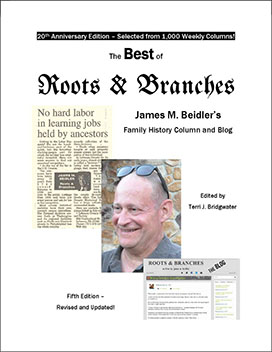
The Best of "Roots & Branches", Fifth Edition published July 2017, edited by Terri J. Bridgwater.
It contains a selection of columns from Beidler’s award-winning newspaper column (currently published in the Altoona Mirror), which is the only syndicated newspaper column on genealogy in Pennsylvania.
The book can be ordered online, or purchased directly from Jim when he speaks at a conference.