

Published July 5, 2026
| | Leave A ReplyI’ve had a chance lately to revisit some of my personal genealogy lines in the last couple of months and while I haven’t found additional ancestors, I think I’m on the way to do so with the help of more records online and a new respect for some old methodologies.
In both of the cases, I think I’ve been able to pinpoint a German Markgrafschaft or Grafschaft of origin but not necessarily the actual village within that political unit (As an aside, the German word Grafschaft is generally rendered in English as “county,” which I feel is a misnomer since it’s not like we think of “counties” in America … it is the domain ruled by a count, so I call them “countships”).
In one case, my longtime friend and genealogy colleague Michael L. Strauss asked me to help him (and other Strauss descendants—of which there are many—for that matter) determine the earlier German origin of the family.
The late “village finder” supreme Annette K. Burgert pinpointed the origins of the two immigrant brothers Albrecht and Philip as Massenbach in Württemberg, but their father Johann Caspar Strauss’s marriage record called him a “citizen of the Ansbach region,” which I’ve determined means the former Markgrafschaft (translated as “margraviate”) of Ansbach, now part of Bavaria, but during the early 1700s an independent state.
Since this former area includes dozens of parishes, I’ve been prowling around them on Archion.de, the German Protestant records supersite, seeing a Caspar Strauss matching the 1675 birth mentioned in Caspar’s 1754 burial record in Massenbach (While there are public family trees online linking this Caspar to a family in Dinkelsbühl, then an imperial city on the edge of the Ansbach region, research in that city’s church records yields only one Caspar Strauss … who died as a child).
In the other case, I was motivated by looking at a file to compile information for an edition of Shamele Jordon’s “Genealogy Quick Start” program and revisited the ancestry of a fourth-great-grandmother Magdalena Rathmacher Reber.
Some two decades ago, I had traced the records of the Rathmachers to Sprendlingen and Partenheim in the former Hessian Rhineland, with the earliest record I found being a 1658 marriage indicating that the father of the groom was a Heinrich or Friedrich Rademacher from the “Grafschaft Mörsch,” which under guidance from the expert FamilySearch Library staff I took to be a village near Frankenthal, with church records to be found in that latter city’s parish.
When I couldn’t find any Rathmachers in the Frankenthal records, I let that drop.
But in revisiting this case, I now think that the countship to which the marriage records refer is actually an adjectival form of the city and namesake countship Mörs in the lower Rhineland.
Unfortunately, the early church records of that area don’t appear to be easily accessible from home, so I may have to wait for an already scheduled trip to Salt Lake to check them out.
For Sale
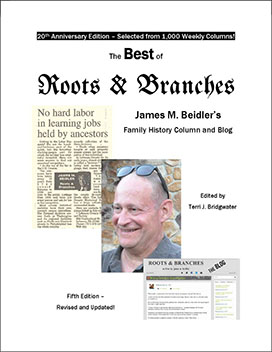
The Best of "Roots & Branches", Fifth Edition published July 2017, edited by Terri J. Bridgwater.
It contains a selection of columns from Beidler’s award-winning newspaper column (currently published in the Altoona Mirror), which is the only syndicated newspaper column on genealogy in Pennsylvania.
The book can be ordered online, or purchased directly from Jim when he speaks at a conference.