

Published July 12, 2026
| 2 Comments | Leave A ReplyIn a “Roots & Branches” column some weeks ago, I noted a had “two dozen or so” direct-line ancestors who fought in the American Revolution.
When several Facebook Friends posted the names and dates of their Revolutionary War ancestors, I felt a little competitive and decided to list mine, too. At this point, I’m confident of 26 such soldiers.
I also realize that I have a number of other individuals born in the “sweet spot” of the 1740s to 1760 who I haven’t researched heavily, so there may be others, too.
And more than just documenting that service, a book and last week’s events celebrating the 250th anniversary of the Declaration of Independence have spurred me to thinking deeper thoughts about these ancestors.
First of all, the book is Dr. Emily Sneff’s When the Declaration of Independence was News (Oxford University Press, 2026, $29.99).
Sneff’s a leading scholar of the Declaration of Independence and her book is both scholarly—don’t forget to read the endnotes, which lead you to her documents and other great books!—as well as written in an approachable way.
She weaves a great tale of how the news about the Declaration spread through broadside printings, public readings, and publications in newspapers … first to the area around Philadelphia (including virtually overnight translation into German—more on that later!), then to the rest of the Colonies cum States, and finally abroad to Britain and the European continent.
One of the “comedy of errors” she relates is that America’s secret agent in France, Silas Deane, was paralyzed by the fact that an official copy of the Declaration didn’t reach him until November!
I also attended readings of the Declaration in English and German at Historic Trappe in Montgomery County during the holiday weekend—as well as seeing a rare copy of the original first printing of it in a German-language newspaper.
Which got me thinking about those 26 Revolutionary War ancestors of mine (as well as the other ancestors living at the time).
How did they first hear or read about it? What was their reaction? Were some of them less than enthusiastic?
From perusing my list, one of the things that interest me was that very few of these men were first generation in this country.
That’s significant to me because starting in 1727, foreign males age 16 and older (primarily these Germans) had needed to swear and sign and oath of allegiance to King George.
The Germans of this time took their oaths very seriously, and anecdotally I’ve heard it caused some of them no little consternation to break such an oath.
But those soldiers of mine were second, third or even fourth generation. They had sworn no oath to Britain, so they were “ready to roll” when the Revolution came.
2 Comments
For Sale
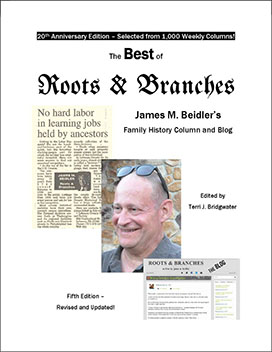
The Best of "Roots & Branches", Fifth Edition published July 2017, edited by Terri J. Bridgwater.
It contains a selection of columns from Beidler’s award-winning newspaper column (currently published in the Altoona Mirror), which is the only syndicated newspaper column on genealogy in Pennsylvania.
The book can be ordered online, or purchased directly from Jim when he speaks at a conference.
Randall Wallett
3 months ago
Thank you for your series of columns about our ancestors and the events of 1776. They have me rereading the histories of my Revolutionary War ancestors and digging a little deeper. Thank you!
James Beidler
3 months ago
You’re welcome and let me know what you find out!