

Published June 14, 2026
| | Leave A ReplyNearly every organization in the United States of America is celebrating the 250th anniversary of the Declaration of Independence, but few are doing it with the style and flair of Historic Trappe, group that interprets four 18th century buildings in that Montgomery County borough.
As I like to do when I have a conflict of interest, I’ll disclose that I’m not completely objective on this organization: its dynamic executive director is Lisa Minardi, the fraktur and material culture expert, my partner Katy Bodenhorn is Historic Trappe’s manager of academic programs, and I’m an occasional volunteer at events there.
Laying all that aside, I can’t help but gush about Historic Trappe’s new exhibition in the five galleries at the Dewees Tavern (one of those four historic buildings that Historic Trappe manages) titled “Window to Revolution: Pennsylvania Germans and the War for Independence.”
The organization describes the exhibit like this: “It explores the pivotal but often overlooked contributions of the Pennsylvania German community during the Revolutionary War.”
The exhibit centers on the prominent Muhlenberg family, who resided at various points in three of the houses Historic Trappe manages, but also includes artifacts loaned from a variety of institutions and individuals.
The Rev. Henry Melchior Muhlenberg, who created order out of chaos for the German Lutherans in 18th century America, resided in one of the preserved houses and literally had the “window to revolution” from his home that was right on the periphery of the battle zone when the British occupied Philadelphia in 1777 and is not far from George Washington’s Valley Forge winter encampment.
The exhibit includes one of Henry Muhlenberg’s voluminous journals, which show the pulse of the community during this time period and his own personal ambivalence about the conflict.
Another artifact in the exhibit is the preserved clerical robe once worn by Henry Muchlenberg’s son Peter, also a minister who raised a battalion of soldiers in Viriginia and, if the legend reported decades later is true, ended his final sermon in 1776 by adapting some biblical verses to proclaim “now is a time for war,” before dramatically shucking that robe to reveal his militia uniform.
Among the artifacts—gathered on loan from such premier institutions as Winterthur Museum and the Moravian Archives in Bethlehem as well as Minardi’s extensive private collection—include flintlock pistols, Continental currency, fraktur drawings by former Hessian soldiers, and a rare German translation of the Declaration of Independence.
“Window to Revolution” runs through Feb. 27, 2028, so there’s plenty of time to get to Trappe for this, but the galleries are so absorbing that you’ll probably want to visit more than once.
Also available to visit is the newly restored Speaker’s House, home to another Henry Muhlenberg son, Frederick, who was the first speaker of the U.S. House of Representatives in
All the details on the exhibit and all of Historic Trappe’s other events are on its website at the URL, https://historictrappe.org/
For Sale
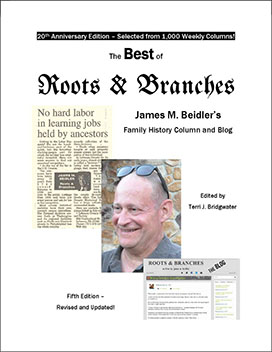
The Best of "Roots & Branches", Fifth Edition published July 2017, edited by Terri J. Bridgwater.
It contains a selection of columns from Beidler’s award-winning newspaper column (currently published in the Altoona Mirror), which is the only syndicated newspaper column on genealogy in Pennsylvania.
The book can be ordered online, or purchased directly from Jim when he speaks at a conference.