
Roots & Branches is an award-winning, weekly newspaper column begun in 1998 that currently is published in the Altoona Mirror. It’s the only syndicated column on genealogy in Pennsylvania!
Posted October 12, 2026 by James Beidler | No Comments
Just last fall, my cousin Cindy Cruz made her first visit to the FamilySearch Library in Salt Lake City and kindly shared with me her impressions for publication in what turned out to be a couple of “Roots & Branches” columns.
The skinny was that—despite the huge amount of digitized material that FamilySearch.org has put online for use on home desktops—there are still a fair number of resources that make a trip to the library worthwhile. These include many books of records abstracts available only there as well as the expertise of staff.
Well, I just returned my own latest trip to Salt Lake—I’ve come almost every year since 1998!—and what Cruz found remains my own general impression, but there’s a few things that I want to add.
A positive was that in an impromptu meeting with Lynn Turner, who’s been director of the library for some four years now after being the No. 2 guy for a few years before that, he told me that the voluminous collection of books relating to Germany has now been scanned and awaiting rights evaluations for remote access.
Naturally, German specialist that I am, this made me happy at the thought of potential increased remote access. Looking at many of these books for both client and personal work had been a major part of my trip this time out, including some collections of German documents dating to late Medieval times!
There were some not so thrilling reminders, too.
The first floor of the library is undergoing yet another transformation, just a few years after it was essentially turned into a tourist spot for visitors whose interest in genealogy is usually far more casual then deep. I didn’t ask what new things are awaiting though my understanding it will be designed to cater to the huge influx of Mormons expected for the temple rededication coming up starting next year.
I also had one particular reference book that was part of the huge “de-spine-ing” project that happened some years ago when FamilySearch apparently got ahead of itself and thought it was going to put all its collection online and then ran into perceived copyright problems.
This particular book, an inventory of all the Protestant parishes in Bavaria including when each of the parishes’ records commence, is now only available in the library on microfilm, and has no easy way to access it in bulk (I’m interested in working through parishes in an entire region of Bavaria).
I realize that FamilySearch cherishes its relationships with repositories and archives and errs on the side of caution in these things.
But sometimes I think they err too much on the side of caution in a way that inconveniences genealogists.
Especially in this particular case of a reference book by a long-deceased author, for gosh sake!
Have You Bought Your Copy?
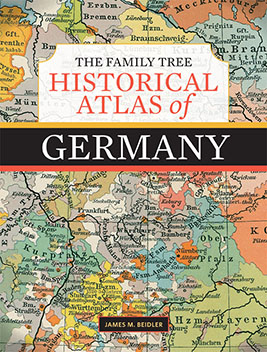
The Family Tree Historical Atlas of Germany, by James M. Beidler
This new atlas brought to you by author James M. Beidler gives you all the maps you need to research your German-speaking ancestors. The areas that area now Germany—as well as Austria, Switzerland and other territories in which German-speaking people resided—are examined from Roman times to the present day, including detail maps from the prime emigration period during the Second Reich. More than a hundred full-color maps!
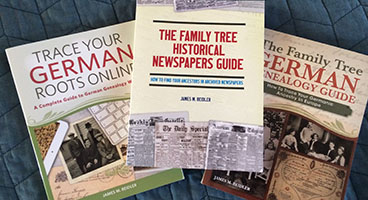
For Sale
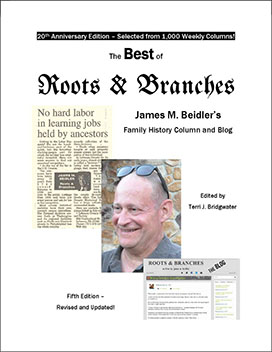
The Best of Roots & Branches
, Fifth Edition published July 2017, edited by Terri J. Bridgwater.
It contains a selection of columns from Beidler’s award-winning newspaper column (currently published in the Altoona Mirror), which is the only syndicated newspaper column on genealogy in Pennsylvania.
The book can be ordered online, or purchased directly from Jim when he speaks at a conference.