

Published May 5, 2026
| | Leave A ReplyI recall in my days as a beginning genealogist some decades ago that family history books—often just dry listings of names, dates, and occasional locations—would frequently punctuate a person’s individual entry in the book as “N/I.”
“N//I” meant “no issue.”
Which is a terse but somewhat fancier way of essentially saying, “This person has no descendants, so why bother researching them!”
I was reminded of this when Sunny Jane Morton, who has put herself in the front rank of genealogy editors, authors, and lecturers in recent years, first broached the idea of a book on Roman Catholic nuns.
Psst, you know these women had no descendants, right?
I’m sure that Morton heard variants of this, in the form of statements or questions, quite a few times in the last few years and I applaud her for soldiering on in the face of such headwinds to produce her book, titled Searching for Sisters: A Guide for Researching Catholic Nuns in the United States.
The premises of Morton’s book, boiled down to the most basic of reasons for genealogists to pay attention, are these:
- While the women joining these orders left their families behind, they assuredly began life as part of families, and therefore your family’s story would be incomplete without them.
- And because there may be nuggets about other family members in the records of women religious, they are part and parcel of a “whole-family genealogy” approach to research.
Along the way, Morton’s chapters give details on determining whether a woman did actually join an order; then, in turn, determining exactly what type of Catholic organization the order was; and finding the archives of said groups (many of which have similar or changing names.
She follows this with the meatiest of the chapters, in which she gives many examples of the types of records in the archives, and then lists the more basic genealogy sources in which sisters can be named.
Along the way, Morton does not put the sisters on a pedestal of flawlessness—they were people, too!—but she urges the reader not to indulge in what she calls “presentism” in judging the women religious solely by today’s ethical standards (She doesn’t shy away from acknowledging the sisters’ involvement in the Native American boarding school movement, now often termed a genocide).
The book also includes some case studies that involve women religious and put into action the methodologies Morton recommends from her previous chapters.
A listing of selected archives concludes the book.
And I’m now emphatic that this book has filled a needed niche in the canon of genealogy research aids.
***
Searching for Sisters: A Guide for Researching Catholic Nuns in the United States, Baltimore, MD: Genealogical Publishing Company, 2026; 134 pages.
For Sale
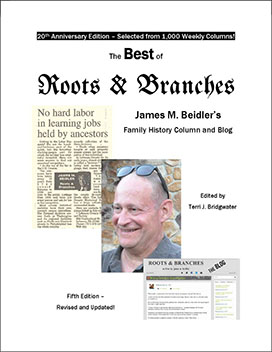
The Best of "Roots & Branches", Fifth Edition published July 2017, edited by Terri J. Bridgwater.
It contains a selection of columns from Beidler’s award-winning newspaper column (currently published in the Altoona Mirror), which is the only syndicated newspaper column on genealogy in Pennsylvania.
The book can be ordered online, or purchased directly from Jim when he speaks at a conference.