

Published September 22, 2026
| No Comments | Leave A ReplyIn helping an individual who had compiled a lot of information about his First Wave German immigrants from a variety of internet sites, some of them without a lot of (or no!) sourcing, I came upon a seminal example of which no iteration of a record set should be ignored—even ones that over time have been relegated to the second or third team.
The record set was the lists of foreigners arriving at the Port of Philadelphia, who beginning in 1727 were required to take an oath of allegiance to the British king for entry.
More precisely: Males age 16 and older were required to take the oath. And while a few full-passenger ship lists remain from this period, the majority of them are just these “males age 16 and older.” These oaths lists—sometimes confused with naturalizations, which they were not—are one of the core record sets of Pennsylvania Germans and offer the teeter-totter point for 18th century immigrants.
The person in question was a Balthasar Maurer, who spent his life in what’s no Montgomery County, Pennsylvania, and seemed to have arrived in the 1740s, based on later church records about him and his family.
The client’s information showed Maurer as well as his infant namesake son arriving on the ship Phoenix on a specific date in 1743. I was able to rule this out pretty quickly: While there was such a ship arriving in Philly on that date … there was no one by a name remotely resembling Maurer on the oaths list in the most authoritative published version of these lists, titled Pennsylvania German Pioneers.
While I was in the Pioneers, I did check for references to a Balthasar Maurer arriving on any dated, and found one in October 1747 and presented this as a possibility. This man signed with an X and the Balthasar in Montgomery County records appeared to be literate, so that was a contradiction that led me to keep looking.
Then as simple Google search brought back references to a Balthasar arriving in 1749. Naturally, I wanted to see the sourcing and it was attributed to the “mother of all immigration sources,” now an Ancestry.com databased, but originally William Filby’s massive “U.S. and Canada, Passenger and Immigration Lists Index, 1500s–1900s.”
Filby is essentially a source of sources, with numerical codes leading to the underlying sources, which in this case was I. Daniel Rupp’s 30,000 Names of Immigrants.
I’ll admit I often pass over Rupp on the way to Pioneers because 30,000 Names rearranged the order of some names, omitted others, and often butchered the transcription of them.
But in this case, Rupp was correct: There was a Balthasar Maurer on the Sept. 2, 1749, arrival of the ship Chesterfield.
He’s also listed in Pioneers but inexplicably does not appear in the Pioneers index.
His Pioneers signature is written Balthasar Mauerle, but the name does appear in the index with that spelling, either (the discrepancy might mean Balthasar was sick on the day of the oaths and that someone else wrote his name for him).
The moral: Seek out all published iterations of a record set!
Leave A Reply
For Sale
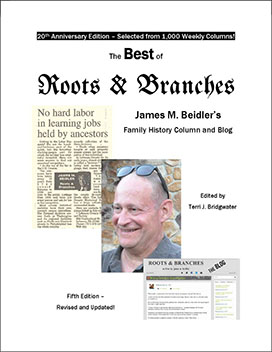
The Best of "Roots & Branches", Fifth Edition published July 2017, edited by Terri J. Bridgwater.
It contains a selection of columns from Beidler’s award-winning newspaper column (currently published in the Altoona Mirror), which is the only syndicated newspaper column on genealogy in Pennsylvania.
The book can be ordered online, or purchased directly from Jim when he speaks at a conference.