

Published November 23, 2025
| | Leave A ReplyThe idea of the Pennsylvania Dutch / Pennsylvania German identity is something of more than passing interest to me.
So when I heard that Kutztown University’s Pennsylvania German Cultural Heritage Center was having an event on Nov. 14–15 that it dubbed “Pennsylvania German Futures,” I knew I wanted to attend (as it turned out, I had a conflict for part of the conference’s second day).
The conference started on the first evening with a keynote address by the center’s director, Patrick Donmoyer, followed by some robust discussion. The second day of the event included a series of panels on topics ranging from material culture to future voices to the status of language.
Panelists included a variety of people ranging from representatives of the “Plain” Pennsylvania Germans—Anabaptists such as Amish and Mennonites—as well as the “Fancy Dutch,” people who are descendants of the mainstream “church people,” who were mostly from the Protestant Lutheran and Reformed denominations.
The panels had many wonderful insights—so many that it was tough for the five people on each panel to contain themselves to the hourlong slots they were given!—but I can boil down them down to a couple of things that resonated the most with me.
Perspectives from speakers on the “Pennsylvania German Language” panel highlighted the importance of that language.
One came from Michigan State University’s Rose Fisher, who was born into the Old Ord Amish community and is completing her Ph.D. work at Penn State University on the topic of the differences between speakers of Pennsylvania German based on geography and religious affiliation.
Another came from Brad Smith, who began a successful program for people to learn the Pennsylvania Dutch language that has now “graduated” hundreds of people and led to further levels of courses. He related a story about children being taught a Pennsylvania Dutch song by Doug Madenford, author of a textbook on the language, and that an older PA Dutchman dubbed the pronunciation as incorrect.
In both these cases, too many people—and I would have been among them at one time—strive to find a consistency of spelling, pronunciation, and idiom that doesn’t exist in the Pennsylvania German language (and frankly is what I’ve come to believe is one of its most charming aspects).
In part because all this month I’ve been immersed in presenting a four-part series on Pennsylvania German genealogy for Historic Trappe, it has gotten me thinking about what it means to be Pennsylvania Dutch in the 21st century.
While I have a long Pennsylvania Dutch ethnic lineage, I don’t have the language skills. Others have the language skills but don’t have the lineage, or at least not much of one.
But I think the Pennsylvania Dutch identity should be open to anyone with an interest, an affinity for “things Pennsylvania Dutch,” and I hope Kutztown holds more conferences to keep that flame burning bright.
For Sale
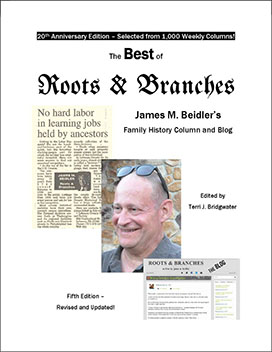
The Best of "Roots & Branches", Fifth Edition published July 2017, edited by Terri J. Bridgwater.
It contains a selection of columns from Beidler’s award-winning newspaper column (currently published in the Altoona Mirror), which is the only syndicated newspaper column on genealogy in Pennsylvania.
The book can be ordered online, or purchased directly from Jim when he speaks at a conference.