

Published August 31, 2025
| 2 Comments | Leave A ReplyIt always great to hear from engaging “Roots & Branches” readers such as Thomas R. Liszka, who’s an associate professor emeritus of English for Penn State Altoona.
He pinged my in box recently with a question on the column published a couple of weeks ago in which I talked about my visit the Leesport Area Historical Society, in which I wrote: “But you never know when there might be a much older reading of a local cemetery that includes tombstones no longer legible.”
This obviously got Liszka’s mind spinning a bit.
“You mentioned readings of cemeteries that include tombstones no longer legible. I didn’t know such things existed,” Liszka asked. “What are they usually called? How do you track them down? Are they usually available through the cemetery or elsewhere? I have two worn tombstones that I really hope someone may have transcribed once upon a time.”
I had based my speculation on some hard evidence of compilations such as the late Oscar Stroh’s Pennsylvania German Tombstone Inscriptions, the first volume of which was printed in the 1970s but based on readings of the markers that dated in some cases to the turn of the 19th into the 20th century (hat tip to my friend Richard Mammana for placing a digital copy of this volume on Archive.org).
Do they exist for all cemeteries? Of course not.
I also expressed my hope to Lizska that he wouldn’t be pursuing a will-o’-the-wisp but urged him to look for repositories at which genealogists’ papers might have been deposited … these inscriptions may not even have been published but could be in manuscript collections.
Two examples of this are direct-line Berks County, Pennsylvania, ancestors of mine—Philip Himmelberger and Nicolaus Kintzer—who died in the 1790s, a time period from which there are fewer and fewer stones that are extant in my area.
I recalled seeing the exact birth dates of Kintzer and Himmelberger in a collection at the Berks History Center of inscriptions copied by the prominent early 1900s historian Michael A. Gruber.
In attempting to retrace those steps to Gruber’s work, I found that they’ve now been digitized by FamilySearch.org, albeit as one of the locked collections only fully available at a FamilySearch Center or the “big house,” the FamilySearch Library in Salt Lake; however, online to all comers is an abstract that’s on the FamilySearch website.
If Himmelberger and Kintzer’s stones still exist at St. John’s (Host) Reformed Church’s old graveyard, they haven’t been readable in the 40 years that I’ve been doing genealogy (Truthfully, I doubt that they even exist in an illegible state there since I have ancestors who died in the mid-1800s whose stones I did see in the 1980s are now gone. Host has treated its legacy as one of the early churches with an attitude of shabbiness, unfortunately).
2 Comments
For Sale
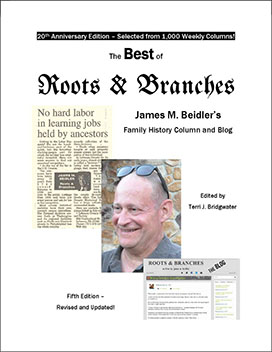
The Best of "Roots & Branches", Fifth Edition published July 2017, edited by Terri J. Bridgwater.
It contains a selection of columns from Beidler’s award-winning newspaper column (currently published in the Altoona Mirror), which is the only syndicated newspaper column on genealogy in Pennsylvania.
The book can be ordered online, or purchased directly from Jim when he speaks at a conference.
Kathy Stouffer
6 months ago
Jim,
Nicholas Kintzer is my husband’s 5th great-grandfather. I have been to Host’s Cemetery several times. Many relatives, including my grandparents, are buried there. I have found the old cemetery to have many tombstones that are illegible. Arthur Schuman’s and Schuyler Brossman’s records, as listed in “History of Host Church 1727-1975,” do not mention a tombstone for Nicholas Kintzer. Schuman’s records date back to sometime before 1963, but since Nicholas died in 1794, the tombstone could have been missing or illegible. The church even admits that prior to Schuman and Brossman’s records, they did not have any records of the cemetery burials. Perhaps a minister took them with him.
My siblings and I are working on a sequel to our book, “Fredericksburg, Lebanon County, Pennsylvania.” We have had locals bring us photos and stories that need to be shared. We even found the tall clock that was saved from the 1827 Stumpstown fire. We are still looking for a photo of the Grove Mill and Grove Mill mansion. But I know you understand the challenges of writing a book. It’s definitely been an adventure.
James Beidler
6 months ago
Last thing first: Great to hear there’ll be a sequel book on Fredericksburg!
On Nicolaus Kintzer and Host: Yeah, sometime between the turn into the 20th c. and the 1960s, stones like those of Kintzer and Philip Himmelberger disappeared, probably due to sheer neglect. 🙁 … as I opined my column, Host seems not to respect its history. double 🙁