

Published March 2, 2026
| No Comments | Leave A Reply
The Southern California Genealogical Society, an organization that’s been a stalwart in the Los Angeles area for decades, recently put out the word that its large volume of so-called vertical files would not be moved when it changes to a smaller library site.
The society was allowing interested researcher to have files of their choice but received some pushback when disclosing that any unclaimed files would be pitched.
“Vertical files,” for the uninitiated, are the epitome of “miscellaneous”—they often contain newspaper clippings, copies of documents, photocopies of family trees, typewritten transcripts, back-and-forth correspondence, and much, much more. The Southern California society has some 7,000 of these files, sorted by family surnames.
The society had tried to interest FamilySearch.org in digitizing the files, to no avail. It says it does not have the resources or webserver space to scan the files themselves.
Some of the “push backers” were saying things along the lines “some other society must want these” but I know from experience with many organizations that nearly all of them are in a crunch of space or resources.
There’s also a bit of a generational divide on the value of vertical files, too.
For genealogists of my generation—ones who are now gray-bearded or blue-haired (I am the former)—who cut our teeth pre-Internet when the latest, greatest tech thing was when the Mormon International Genealogical Index changed from microfiche to CD-ROMs, browsing through vertical files in a repository was always a box to check.
Younger genealogists, who maybe sometimes take for granted the easy, searchable desktop access to the U.S. Census and so many other tools, perhaps have less need for vertical files.
And truth be known, many of those items I cited a few paragraphs back are indeed now available on the Internet. Many of the photocopies in these vertical files of documents created with old analog printing processes are now much easier to read (and image) with today’s digital technology.
And, another truth be known, what I would have considered at one time to be my “crown jewel” of a find from vertical files has reinforced to me the maxim of “prove it yourself” that just about every greenhorn genealogist violates.
Fairly soon after I had begun genealogy, I encountered a pedigree chart in the vertical files of the Lebanon County Historical Society.
This chart linked into my Rupp line and showed several generations of Rupps, Siegchrists, Heilmans, and Richerts that could be added to my family tree.
What I didn’t know until I tried verifying the chart some time later was that there were two women named Anna Catharina Heilman (first cousins, as it turned out) born within a close amount of time in 1768.
The chart in the vertical file had the “wrong” Anna Catharina Heilman attributed as the wife of my ancestor Johannes Rupp.
Still and all, I grieve that there might be a file or two lost with unique and correct information that gets lost.
The society was allowing interested researcher to have files of their choice but received some pushback when disclosing that any unclaimed files would be pitched.
“Vertical files,” for the uninitiated, are the epitome of “miscellaneous”—they often contain newspaper clippings, copies of documents, photocopies of family trees, typewritten transcripts, back-and-forth correspondence, and much, much more. The Southern California society has some 7,000 of these files, sorted by family surnames.
The society had tried to interest FamilySearch.org in digitizing the files, to no avail. It says it does not have the resources or webserver space to scan the files themselves.
Some of the “push backers” were saying things along the lines “some other society must want these” but I know from experience with many organizations that nearly all of them are in a crunch of space or resources.
There’s also a bit of a generational divide on the value of vertical files, too.
For genealogists of my generation—ones who are now gray-bearded or blue-haired (I am the former)—who cut our teeth pre-Internet when the latest, greatest tech thing was when the Mormon International Genealogical Index changed from microfiche to CD-ROMs, browsing through vertical files in a repository was always a box to check.
Younger genealogists, who maybe sometimes take for granted the easy, searchable desktop access to the U.S. Census and so many other tools, perhaps have less need for vertical files.
And truth be known, many of those items I cited a few paragraphs back are indeed now available on the Internet. Many of the photocopies in these vertical files of documents created with old analog printing processes are now much easier to read (and image) with today’s digital technology.
And, another truth be known, what I would have considered at one time to be my “crown jewel” of a find from vertical files has reinforced to me the maxim of “prove it yourself” that just about every greenhorn genealogist violates.
Fairly soon after I had begun genealogy, I encountered a pedigree chart in the vertical files of the Lebanon County Historical Society.
This chart linked into my Rupp line and showed several generations of Rupps, Siegchrists, Heilmans, and Richerts that could be added to my family tree.
What I didn’t know until I tried verifying the chart some time later was that there were two women named Anna Catharina Heilman (first cousins, as it turned out) born within a close amount of time in 1768.
The chart in the vertical file had the “wrong” Anna Catharina Heilman attributed as the wife of my ancestor Johannes Rupp.
Still and all, I grieve that there might be a file or two lost with unique and correct information that gets lost.
Leave A Reply
For Sale
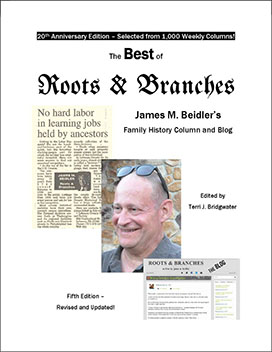
The Best of "Roots & Branches", Fifth Edition published July 2017, edited by Terri J. Bridgwater.
It contains a selection of columns from Beidler’s award-winning newspaper column (currently published in the Altoona Mirror), which is the only syndicated newspaper column on genealogy in Pennsylvania.
The book can be ordered online, or purchased directly from Jim when he speaks at a conference.