

Published November 8, 2025
| | Leave A ReplyI’ve been in touch with Greg Biehl ever since I happened to bump into him when he visited the Genealogical Society of Pennsylvania a few years ago during my time as interim executive director there.
It didn’t take much conversation then for us to realize we were distant cousins, both descendants of a Peter Biehl who settled during the 1740s in what later became eastern Berks County (Greg, of course, comes by his Biehl line most honestly since it’s his surname line; I’m related because my ancestor Heinrich Beidler (1798–1869) married Anna Maria “Polly” Biehl, who was the daughter of Christian Biehl, a grandson of the likely immigrant Peter).
Greg Biehl reached out to me with a question about the 1810 U.S. Census. He’s been trying to research two generations of his Biehl line who were both named Abraham. In the 1810 census, he found an Abraham in the Berks county seat of Reading, but with several columns of information beyond the standard census form.
“I searched to try to figure out what the additional data represented, but couldn’t find any information on-line,” Biehl wrote to me. “I was thinking it may be related to property, but not sure. I was wondering if you know what information was contained in the additional columns?”
I didn’t know the answer to this offhand, but I had an idea on how to find out. First of all, I dusted a classic genealogy book, Kathleen Hinckley’s Your Guide to the Federal Census for Genealogists, Researchers, and Family Historians and it gave me a clue that it might be a manufacturing census that was included in some of the early censuses.
But that was just a clue, and even looking at the National Archives’s website didn’t offer more information, so it was time to roll up the sleeves and just dive into the 1810 census for Berks County.
What I found was that only a few of the Berks Co returns even have this extra second page! And only one that I could find actually identified what the columns actually stood for.
Greg Biehl was basically correct—the headings are for personal property that’s often found in the tax lists of this time period, documenting the number or other quantity of: horses, cattle, sheep, linen, cotton, and cloth (there were some headings for which the handwriting was too difficult to read so I left those for Greg to figure out!)
The moral to this particular story is that sometimes you have to go beyond the records that relate to the person you’re researching and look to other documents to be your “Rosetta Stone” of sorts to decode what you’re looking at.
And I applaud Greg for not just shrugging off something he couldn’t understand and instead call in some extra help to figure it out!
For Sale
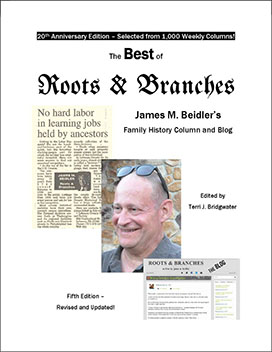
The Best of "Roots & Branches", Fifth Edition published July 2017, edited by Terri J. Bridgwater.
It contains a selection of columns from Beidler’s award-winning newspaper column (currently published in the Altoona Mirror), which is the only syndicated newspaper column on genealogy in Pennsylvania.
The book can be ordered online, or purchased directly from Jim when he speaks at a conference.