

Published July 27, 2025
| 2 Comments | Leave A ReplyIt seems like I’ve written this column before.
And truth be known, in my more than a quarter century of writing “Roots & Branches,” I’ve returned to the topic of the value of historical newspapers several times.
I guess that happens when your “Roots & Branches” columnist is both: a) the author of the only full-length, commercially published book on this topic, The Family Tree Historical Newspapers Guide and b) a former newspaper copy editor.
But there’s nothing that brings out my evangelical zeal like trying to convert family historians to fully use newspapers.
Yep, I said it: “fully use” newspapers, not just reply “Oh, I’ve found my ancestor’s obituary” when they’re asked if they’re checked out newspapers.
That’s because an obituary might document the end of your ancestor’s life, but in many cases it only should be the beginning of your research in historical newspapers.
What brings this all back to my mind is the upcoming course I’m putting together for Family Tree University titled, “Heritage Headlines: Strategies for Tracing Your Roots in Newspapers.”
The course begins with a two-hour-plus webinar session on Aug. 11 starting at 6 p.m. EDT and then offers two weeks of discussion time with your “Roots & Branches” columnist.
Among the items to explore during the webinar are the major digitized newspaper websites, from free resources like Chronicling America and Old Fulton Post Cards to subscription services such as Newspapers.com, GenealogyBank.com, and NewspaperArchive.com.
An important facet of newspaper research that the course will cover is using the right resources to determine all the newspapers ever published in your area of interest (people often underestimate how many newspapers used to cover just one area!).
The course will also show the many times of information that used to be in newspapers, including “social” columns with information as granular as who was visiting who in a particular town. Newspapers truly were the social media of the 19th century!
Something that people new to researching digitized old newspapers don’t always realize is how the searchability is created—and the pitfalls of that creation. When a newspaper is digitized, it is run through optical-character recognition (OCR for short) software and inevitably some characters are misread; the course will suggest a variety of workarounds for this.
Importantly, the webinar will show that biographies of ancestors can be built one short newspaper mention at a time.
The webinar also will cover more than just the websites with digital newspapers; also included will be websites of present-day newspapers and ways to aid your research with unpublished abstracts created by genealogical societies as well as issues on microfilm or bound books of the original paper-form issues.
Registrants will also get access to a recording of the live webinar in case they aren’t available for the Aug. 11 live webinar.
***
You can register for “Heritage Headlines” at the Family Tree University website’s URL, https://store.familytreemagazine.com/products/heritage-headlines-strategies-for-tracing-your-roots-in-newspaper-september-2025
2 Comments
For Sale
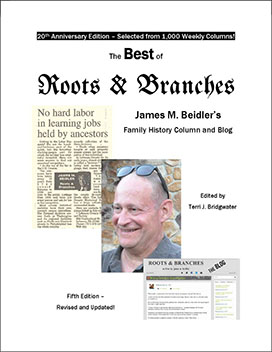
The Best of "Roots & Branches", Fifth Edition published July 2017, edited by Terri J. Bridgwater.
It contains a selection of columns from Beidler’s award-winning newspaper column (currently published in the Altoona Mirror), which is the only syndicated newspaper column on genealogy in Pennsylvania.
The book can be ordered online, or purchased directly from Jim when he speaks at a conference.
Rick Bender
7 months ago
Jim, we’ve (you and I) been on a parallel genealogy-research course for decades. I noticed the hidden value of old newspapers just about the same time you started talking about them. In my research they have proven most helpful, sometimes even invaluable. I try to tell people how much information is in them, if you drill down into them — many little things that appear in those passing newspaper items can solve mysteries, or at least, give some clues as to where to look in the church and government records. For me, it’s been incredible — phenomenal! Even though I’m finishing up my research, I’ve joined this coming event just in case there’s still more out there for me to discover.
James Beidler
7 months ago
Thanks, Rick! I agree about the parallel lives!! 🙂