

Published March 28, 2026
| No Comments | Leave A ReplyAs described in the last two installments of “Roots & Branches,” when I accidentally made my way into the professional genealogy world, my pursuit of my personal family history took a bit of a back seat.
But even though I was fortunate enough to have four books on genealogy commercially published in the 2010s—as well as working full time for three years for the research-for-hire firm Legacy Tree Genealogists—I started making sure I also spent time on some of my personal lines.
In concert with that, I also made sure as best I could that I was keeping up with new finds and methodologies in my specialty of German genealogy. I accomplished this primarily by attending two weeklong courses on that topic (labelled intermediate and advanced) at the GRIP genealogy institute.
Coordinated by Warren Bittner with some sessions taught by Daniel Jones, these institute courses left me feeling that I was giving people the best information, whether it’s through lectures, my bimonthly column in German Life magazine, and (of course) this column. Many of my personal genealogy finds, too, have been assisted by this continuing education.
Over time my enthusiasm for doing research-for-hire cases has dwindled (I still have one pending that I want to solve and hopefully will write about that if—when!—it happens), but as life would have it, I now have someone to recommend to them. Katy Bodenhorn, who I first came to know as a coworker when we both were with Legacy Tree Genealogists, is now my partner.
To me it’s only fair that I pass along what I’ve learned from so many mentors, only a few of whom ae still alive.
Laurel Miller, who I’m glad pushed me into doing the Journal of the Berks County Genealogical Society, and Hank Jones, the seminal genealogist of the 1709 Palatines to New York (which include 15 of my families!), are both still around.
But Annette Burgert, the leading “village finder” of the Germans who came after those studied by Jones, has passed on. Don Yoder, who a foundational figure in Pennsylvania German genealogy, is also no longer alive.
Corinne Earnest, considered the leading authority on Pennsylvania German fraktur certificates in the late 20th century, was taken far too early.
There was Shirley Brown, who was supportive of me in so many ways—everything from helping research my book on the Lebanon County Daub family to co-chaperoning a bus trip to the National Archives in Washington, D.C.
And no matter how much further my genealogical journey takes me, I will always be both happy and sad for the mentorship of the late John T. Humphrey. Happy for all of his lectures and writing (and social times!) and sad that he died so prematurely.
Leave A Reply
For Sale
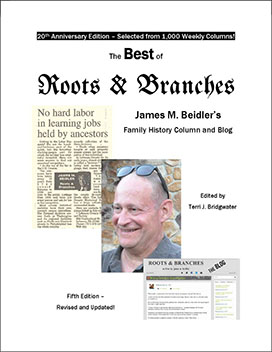
The Best of "Roots & Branches", Fifth Edition published July 2017, edited by Terri J. Bridgwater.
It contains a selection of columns from Beidler’s award-winning newspaper column (currently published in the Altoona Mirror), which is the only syndicated newspaper column on genealogy in Pennsylvania.
The book can be ordered online, or purchased directly from Jim when he speaks at a conference.