

Published September 20, 2025
| 2 Comments | Leave A ReplyI recall 40-something years ago when I was cutting my teeth as a genealogy hobbyist—which for me turned out to be “Pennsylvania German farmer stacked atop another Pennsylvania German farmer”—that I had a lot of ideas common to greenhorns in family history.
I thought that spellings of surnames would have a neat and tidy evolution.
Likewise, I thought I’d see a change from High German to the Pennsylvania Dutch dialect in written records.
I also thought that it would be the exception to find church records of the same family in different congregations or across the lines of religious denominations
And I thought, quite naturally, that the derivation of calling the ethnic group the “PA Dutch” was due to the phonetic similarly it bore to the word in the German language for German, which is Deutsch.
None of these things were true.
So now, with my only worry being immodesty, I’m working on putting together a month of definitive presentations—available in person or online—on Tuesdays in November for Historic Trappe in Montgomery County under the title, “Pennsylvania German Genealogy Lecture Series (If You’re PA Dutch, You’ve Got Much!).”
It’s an ambitious project to distill what I’ve learned in 40 years from well-known mentors such as Henry Z “Hank” Jones and the late Annette K. Burgert, as well as John Grimes, Patrick Donmoyer, and Alice Spayd (and I’m leaving a lot of people out!).
Historic Trappe is home to the Center for Pennsylvania German Studies, with a dynamic staff led by Executive Director Lisa Minardi, an expert herself in so many aspects of Pennsylvania German culture, from furniture to fraktur. The main thrust of the series will be talking about German settlement in Pennsylvania and the records that are unique to this ethnic group.
Each session will have a different focus:
- On Nov. 4, “Session 1: An Enduring People and Where to Research Them,” starts with today’s Pennsylvania Germans, both those who remain distinctive (such as Amish and Mennonites) as well as the descendants of the “church Germans.” Included will be a rundown of cultural institutions that have significant Pennsylvania German holdings.
- “Session 2: Unique Records Begun in the 18th Century” on Nov. 11 will hone in on the records that exist for Pennsylvania Germans but almost no one else in Colonial times! (You’ll come out of this session being glad you don’t have Scots-Irish ancestry!), and also touch on the interrelated language skills of German vocabulary, deciphering the cursive script used in handwritten records, and the fraktur font used in printed materials until the 1930s.
- Then on Nov. 18, “Session 3: Place in Other Common Genealogy Records,” puts the group in the context of more common records used for genealogy such as the U.S. Census and courthouse records, but including some added quirks about the Pennsylvania Germans.
- Finally, “Session 4: Where They Came From and Getting Them Back There” on Nov. 25 looks at all the ways to uncover the “holy grail”—immigrant hometowns in Europe (hint: they’re not always in today’s Germany!).
The series will run from 7 to 8 p.m. Nov. 4, 11, 18, and 25 at St. Luke’s Fellowship Church, 200 W. Main St. Trappe, PA 19426.
Tickets ($40 for Historic Trappe members and $50 non-members) are available as a package for all four sessions; registrants will receive a webinar link to attend virtually before the first lecture. Feel free to attend any or all in person or online. Recordings will be available by request only.
To register, go to the Events tab of Historic Trappe’s website at the URL: https://historictrappe.org/
2 Comments
For Sale
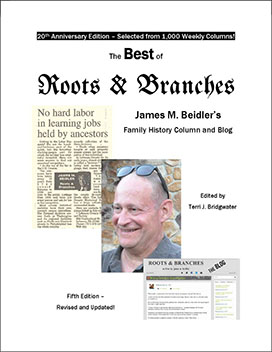
The Best of "Roots & Branches", Fifth Edition published July 2017, edited by Terri J. Bridgwater.
It contains a selection of columns from Beidler’s award-winning newspaper column (currently published in the Altoona Mirror), which is the only syndicated newspaper column on genealogy in Pennsylvania.
The book can be ordered online, or purchased directly from Jim when he speaks at a conference.
MELVIN S KLEIN
6 months ago
Will this include my German families in Potter County, PA? Klein, Brehmer, Schadenberger, Yost, Wagner or Kaufman?
James Beidler
6 months ago
… It’ll be especially useful for tracking the Potter Co families back to their origins in PA. I can guarantee you they didn’t plop down in Potter originally.