

Published November 17, 2025
| | Leave A ReplyWhen the email came in from Michael Braunger, my expectations of an interesting conversation were somewhat limited.
“I researched my surname back to my fifteeenth-great-grandfather (born late 1300s), who may have been the first surnamed ancestor,” Braunger wrote.
That piqued my interest, but a lot of people have theories that aren’t backed up by documents; however, then Bruanger proved he was way above the average researcher.
“Could the surname have derived from the location he came from? My ancestor was a Kornelier, who was part of a community of families who had a relationship with the Buchau Abbey. The abbey encouraged Korneliers to marry within the community. One of the other villages with Korneliers was Braunenweiler.”
A little research in Wikipedia told me that subjects of the imperial Buchau Abbey (today near the city of Bad Buchau) known as Kornelier Leute were encouraged to intermarry even when they left for other villages such as Ingerkingen. “Archival records show a limited presence of the Braunger surname in Ingerkingen in the 1470s. There was a family of seven siblings who inherited a share of the Kornelier property known as Braungergut following the death of their father Hanns Braunger,” Michael Braunger wrote.
“I originally concluded that all Braungers descend from one of three individuals with the surname who resided in neighboring villages. Two of these ancestral trees go back the early 1600s and the third back to the 1400s. I then had my Y chromosome tested against descendants of the other two Braungers. The test results confirm that we share a common ancestor, thus back to 15th century Ingerkingen,” according to Michael Braunger.
“My conclusion is that the brother Hanns and Hainz Braunger’s father, my fifteenth-great-grandfather, was the original Kornelier and perhaps the first to use the Braunger surname. He was likely born in the second half of the 14th century as a time when surnames were not yet universally in use,” Michael Braunger wrote.
Archival records show a limited presence of the surname in Ingerkingen in the 1470s. There was a family of seven siblings who inherited a share of the Kornelier property known as Braungergut following the death of their father Hanns Braunger. “There was also a Hainz Braunger who likewise had inherited a share of Braungergut. I concluded that he was likely a brother to Hanns Braunger and that they had each inherited a share of the Kornelier property from their father, my fifteenth-great-grandfather. The only other Braunger identified at that time was an Erhart Braunger, who likewise was identified as a relative of the seven siblings,” he wrote.
This tracks what had been my previous knowledge: That peasants who took specific geographic surnames did so when they left a village because that surname made them distinctive from others who were native to the area.
It was great to see Braunger take this from theory to reality!
For Sale
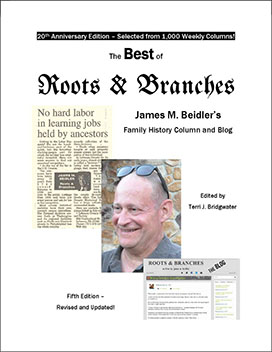
The Best of "Roots & Branches", Fifth Edition published July 2017, edited by Terri J. Bridgwater.
It contains a selection of columns from Beidler’s award-winning newspaper column (currently published in the Altoona Mirror), which is the only syndicated newspaper column on genealogy in Pennsylvania.
The book can be ordered online, or purchased directly from Jim when he speaks at a conference.