

Published March 10, 2026
| No Comments | Leave A ReplyThere are a lot of ways that the dating of events in history can go off the rails—and I’ll admit I’ve taken a few rides away from the tracks myself over the years!
But a recent post in the Facebook group Lehigh County Genealogy had me re-examining some of my assumptions, which is always a good thing to do periodically.
Or maybe even daily, for that matter.
The post involved a church named Ziegels Union Church in what’s now Weisenberg Township, Lehigh County, which was founded in the middle of the 1700s with German Reformed and Lutheran congregations and has remained with shared real property through several church buildings—including two that were destroyed by fires from lightning strikes!—to the present day.
The Facebook post was asking about the origins of Ziegels, in particular when the union church agreement was created. Many published sources have dated the document as being signed in 1750, and indeed the church itself last year celebrated its 275th anniversary on that basis.
But the late Raymond E. Hollenbach, a leading genealogist of northeastern Berks County and southwestern Lehigh County who was active for much of the 20th century, made a claim that the document was actually from 1753.
When I saw this post, I immediately went to my go-to for church histories, Charles H. Glatfelter’s Pastors and People. His volume on the Reformed and Lutheran congregations of the 18th century is considered the gold standard, and he accepted the dating of 1750, brushing off the fact that the first pastor for the Lutherans, Jacob Schertlin, didn’t arrive in America until 1752 by saying he must have signed on later, which was an acceptable theory since the pastors would have been added signatories.
But Hollenbach’s local expertise went deeper: For one thing, one of the lay signatories did not arrive in America until 1751, making 1750 impossible.
But the real clincher was that Hollenbach found the July 29 dating of the church building dedication subsequent to the agreement—expressed as the liturgical calendar date of “7th Sunday after Trinity”—could only have occurred in 1753.
“By consulting a ‘perpetual’ calendar one finds that the only year that fits this date in that decade is 1753,” Hollenbach wrote. “In that year Easter came on April 8th, and the 7th Sunday after Trinity was therefore July 29th. The first church at Ziegel Church was therefore dedicated July 29, 1753.”
Hollenbach, however, didn’t get quite everything right in his historical preface. He wrote that the congregation gained its name Ziegel from its second church building’s tile roof (since Ziegel means tile in the German language).
But in the documents from 1753 when the church’s land was purchased, it is already called the “Ziegle Church Tract,” so the first building must have also had tiles.
Truly a case of always going back to all the original sources!
Leave A Reply
For Sale
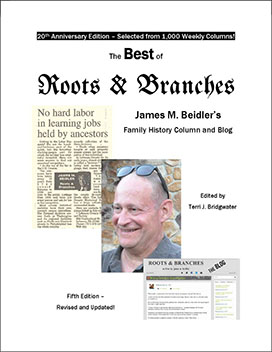
The Best of "Roots & Branches", Fifth Edition published July 2017, edited by Terri J. Bridgwater.
It contains a selection of columns from Beidler’s award-winning newspaper column (currently published in the Altoona Mirror), which is the only syndicated newspaper column on genealogy in Pennsylvania.
The book can be ordered online, or purchased directly from Jim when he speaks at a conference.