

Published November 30, 2025
| | Leave A ReplyI first encountered the difference between mere stories and actual history from the late Charles H. Glatfelter, when I read his classic study of early mainstream Lutheran and Reformed ministers and congregations titled Pastors and People, which documented the beginnings of individual 18th century churches.
Glatfelter took a pretty sharp knife to congregations that relies solely on traditions without evidence, and had an unsubtle narrative touch, to boot. One example, this one about a Lebanon County church:
“There is a charming and old tradition that in 1750 Peter Walmer told his six sons: ‘Boys, we must have a church.’ And six days later, they had a thirty by thirty-two foot building, complete except for the floor. Until there is some historical evidence to deal with, we must regard this for what it is: a charming and old tradition, with no known basis in fact.”
This was recalled to my mind when Blair County historian Stephen A. Kleiner Sr. sent me a link to his article titled “The True History of William and Adam Holliday: Beyond the Folklore,” which examines the early Holliday family and the founding period of what became Hollidaysburg.
“The paper distinguishes verified archival records from long-circulated local folklore and cites original sources from the Colonial Records of Pennsylvania and published Pennsylvania Archives,” Kleiner wrote.
What he has put together is a definitive debunking of the myths put into place by Uriah J. Jones’s History of the Early Settlement of the Juniata Valley in the mid-19th century, mostly by using primary sources and buttressed by the work of another well-known regional historian, Larry D. Smith.
The crux of Kleiner’s debunking work is that William and Adam Holliday were living in what’s today Franklin County in 1768 when Jones’s fanciful narrative has them arriving in the area of what became Hollidaysburg. Kleiner notes that Jones “often provides no sources or references, other than the collective memories of some older citizens at the time the book was written.”
By making reference to the actual land records, Kleiner instead shows that William Holliday didn’t settle in the area that became Hollidaysburg until 1775 and Adam not until the 1790s.
Kleiner also thoroughly analyzes records of Holliday Revolutionary War soldiers and shows that some of the service often attributed to William and Adam was likely actually their later-generation namesakes.
The work of historians such as Kleiner and Smith is vital for “setting the record straight” because Kleiner notes that Jones’s unsourced accounts are still being used on plaques and in print by many folks who don’t seem to know any better.
And that’s just a shame, because as Kleiner’s paper shows, there are ample contemporary sources from the 1700s that tell the real story.
Kleiner’s full paper can be read or downloaded at this URL:
https://archive.org/details/beyond-the-folklore-william-and-adam-holliday/
For Sale
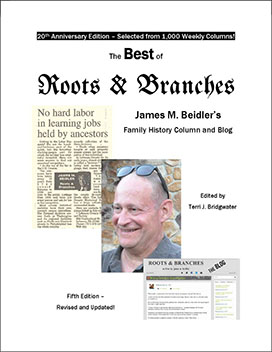
The Best of "Roots & Branches", Fifth Edition published July 2017, edited by Terri J. Bridgwater.
It contains a selection of columns from Beidler’s award-winning newspaper column (currently published in the Altoona Mirror), which is the only syndicated newspaper column on genealogy in Pennsylvania.
The book can be ordered online, or purchased directly from Jim when he speaks at a conference.