
Published August 24, 2025
| | Leave A ReplyEver read a book that you feel you need to recommend in spite of—or even because of—its flaws?
Well, that’s the way I feel about Karin Wulf’s book Lineage.
The author and her book were put on my radar screen when Wulf appeared at the Historical Society of Pennsylvania in Philadelphia last month. She’s the director and librarian of the John Carter Brown Library at Brown University in Rhode Island and has been researching her book intermittently for decades.
My recommendation is based on Wulf, who was perfectly frank that she is not herself a genealogist, being able to make studying the uses of genealogy during the colonial and early American republic eras into a subject of academic analysis.
This is significant since too often historians and genealogists have been uneasy playmates in the same overlapping sandbox (if you need further evidence, ask me about the back-and-forth relationship between HSP, the venue for Wulf’s appearance, and Genealogical Society of Pennsylvania, which I’ve helmed twice in the last quarter century).
Wulf’s at her best when she hones into the complexities and ironies of how the patriarchal society of British America relied on regulation of women’s sexuality to determine legitimacy of with births and created new laws that greatly expanded the institution of hereditary enslavement by decreeing that children had the status of their mothers; that is, if the mother was enslaved, her children (and further generations) were deemed to be so, too.
She also profiles the genealogical activities of Founding Fathers ranging from Benjamin Franklin to George Washington to Alexander Hamilton to show that a keen sense of family history was common to them all.
And for less illustrious folks (but still the middle to upper class of the day), she shows the great variety of family Bibles, registers, diaries, business ledgers, and scraps of paper upon which families recorded the data about their kin. In so doing, Wulf also exposes the reader to the many repositories where such items have been preserved.
On the flip side, many of Wulf’s illustrative documents appear to be camera shots and I’m a typical genealogist who wants to examine and read them, which isn’t possible with many of them. Likewise, there are more lapses of editing than one would expect in a commercially published book.
She also gives a curiously incurious description of the origins of the genealogical thrust of the Church of Jesus Christ of Latter-day Saints (and of the church in general) in her Epilogue.
All that said, Wulf’s command of prose was appealing to me, with such sentences as: “Genealogy has been both a meaningful gift and a form of theft, as family relationship information is coveted and treasured and yet extracted and deployed in ways that family never intended or could ever imagine.”
Indeed!
***
Lineage: Genealogy and the Power of Connection in Early America by Karin Wulf (Oxford University Press, 2025).
For Sale
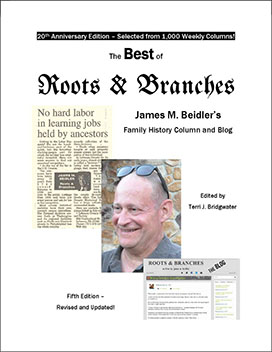
The Best of "Roots & Branches", Fifth Edition published July 2017, edited by Terri J. Bridgwater.
It contains a selection of columns from Beidler’s award-winning newspaper column (currently published in the Altoona Mirror), which is the only syndicated newspaper column on genealogy in Pennsylvania.
The book can be ordered online, or purchased directly from Jim when he speaks at a conference.